
🇯🇵日本語
東京で暮らしていると、「家族」という単位がどんどん小さくなる感覚がある。
核家族が当たり前になり、隣人との距離も、用件のある時だけ近づくものになっていく。
けれど世界には、境界がもっと柔らかい場所がある。
助け合いが“制度”ではなく“呼吸”として残っている場所がある。
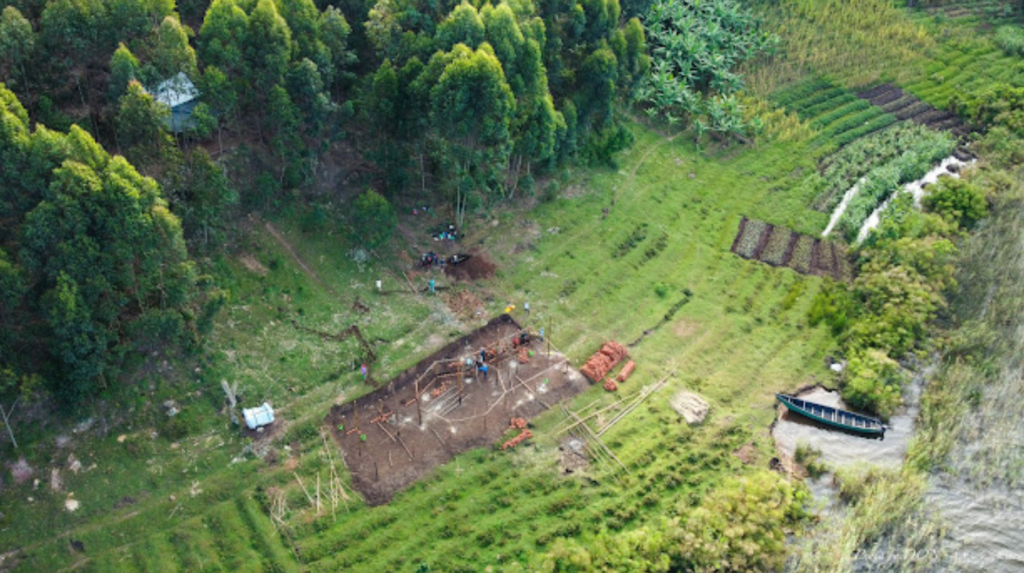
高須さんが人生を賭けて取り組む「天地(あわ)の宮」プロジェクトは、そんな場所──アフリカ・ウガンダ南西部、レイク・ミュータンダのほとりから始まっている。
目指すのは、2050年に向けて、五大陸・100カ国以上の人が関わる国際コミュニティを形にしていくこと。
ただしそれは「コミュニティを作ること」自体が目的ではない。
彼が繰り返し口にしたのは、「愛」という言葉だった。
そして、その愛を“文明”として実装する、というスケールの大きい話だった。
2050年へ向けて──「国際コミュニティ」をつくる理由
高須さんが掲げるのは、2050年までに国際コミュニティを育てていく構想だ。
数字だけを聞くと途方もない。けれど、話を丁寧に追っていくと、彼の意図は「大きくすること」ではなく、“モデルをつくること”にあると分かってくる。
現代の社会は、技術も物も豊かになった一方で、幸福度が比例しているとは言い切れない。
「便利になれば幸せになる」という単純な線では結ばれていない。
その違和感が、彼の根底にある。
「新製品が売れればいいとか、便利になっていけばいいじゃなくて、不便の中に幸せもあったりする。」
“目に見える発展”と“心の充足”の間にあるズレ。
そのズレを、ひとつの場所で検証し、世界へ持ち帰れるモデルにしたい。
それが「天地(あわ)の宮」の出発点として語られた。
「縄文×令和テクノロジー」──戻るのではなく、融合させる
高須さんは、しばしば「縄文」という言葉を使う。
ただし、それは「昔に戻ろう」という懐古ではない。むしろ逆だ。
縄文に象徴される“助け合い・支え合い”の価値観と、令和のテクノロジーを融合させて、今の時代にふさわしい形で実装していく。
彼はそれを「愛の文明」と呼ぶ。
この発想のベースにあるのは、「人と人の距離」への視点だ。
東京の暮らしで強く感じる“境界線の硬さ”に対して、アフリカには“境界線の薄さ”が残っている。
「隣の近所の人たちが困ってたら塩を貸してあげる、調味料を貸してあげる…人と人との距離が近くて境目がない。」
“共同体の感覚”が、生活の地肌として存在している。
それをただ美化するのではなく、現代の技術と掛け合わせて、未来へ持っていく。
その意志が、「縄文」という言葉の使い方に表れていた。
高須さんが語る「愛」──寄り添い、受容し、目に見えないものまで配慮する
愛という言葉は、人によって定義が違う。
だからこそ、ここを言語化できるかどうかは大事なポイントだった。
高須さん自身も、「愛を定義するのは難しい」と前置きしながら、体験を通して掴んできた輪郭を語ってくれた。
アフリカで感じたのは、“全ての人を受け入れる温かさ”。
日本で感じたのは、“相手の変化を察知して合わせる細やかさ”。
旅館での体験として挙げてくれたのは、温泉に入っている間に、食前酒の梅酒が「ちょうどいい氷の溶け具合」で出てくるように計算されていた、という話。
そこには、「相手基準で読み、合わせる」日本的な“寄り添い”がある、と。
「寄り添うって、相手基準で相手が何を求めているかを丁寧に察知してあげながら合わせていく。」
さらに彼は、茶道・武道・華道のような「道」の精神にも触れた。
勝ち負けではなく調和へ向かうこと。空間や“目に見えない領域”まで含めて美を扱うこと。
愛を「優しさ」だけに限定せず、精神性として捉えている姿勢が印象的だった。
舞台はウガンダ・レイクミュータンダ──「絶景と愛」が残る場所
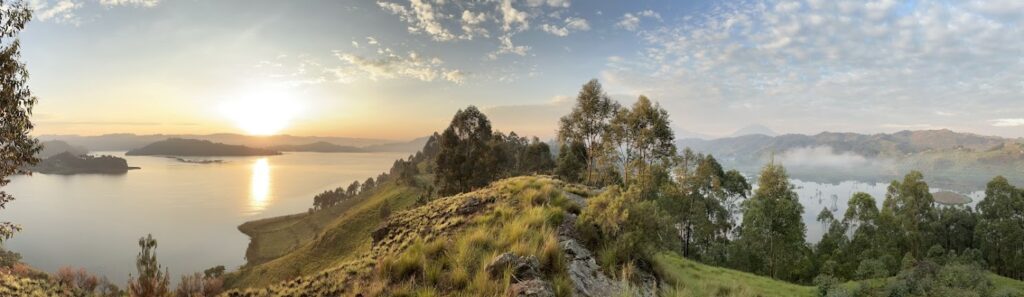
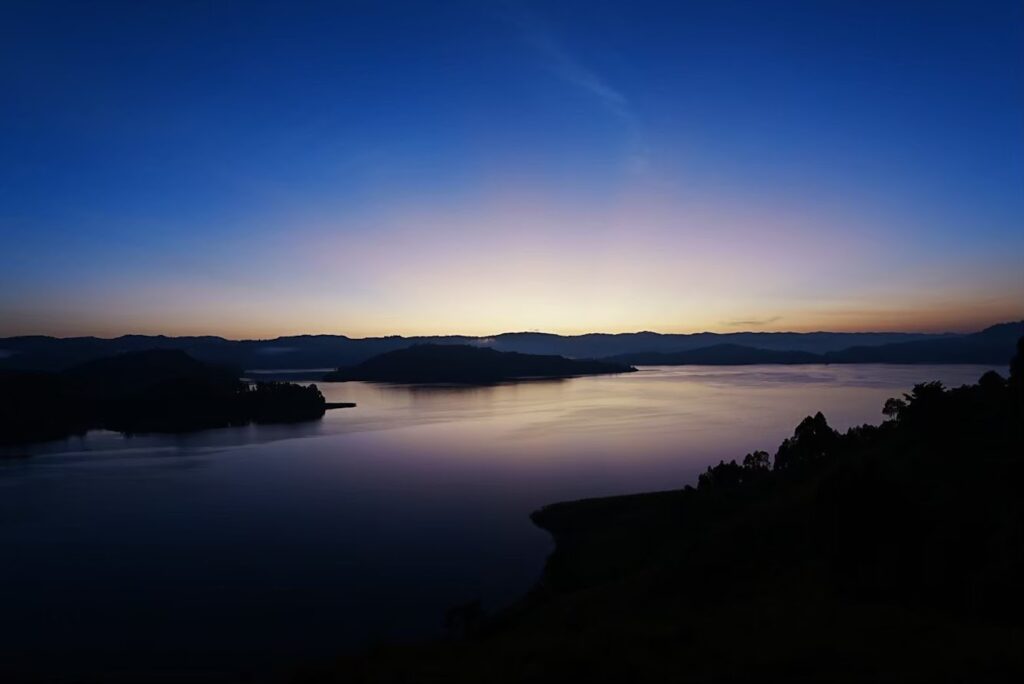
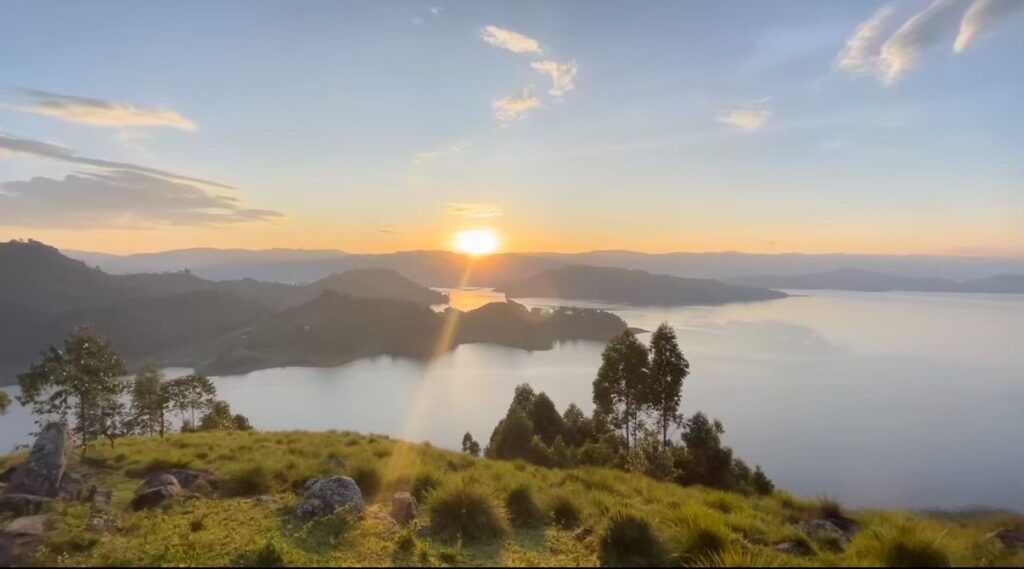
プロジェクトの中心地として語られたのは、ウガンダ南西部のレイク・ミュータンダ周辺。
高須さんは、アフリカを十数カ国旅した末に、最終的にこの場所に辿り着いたという。
彼がこの地を特別視する理由は、単に景色が美しいからではない。
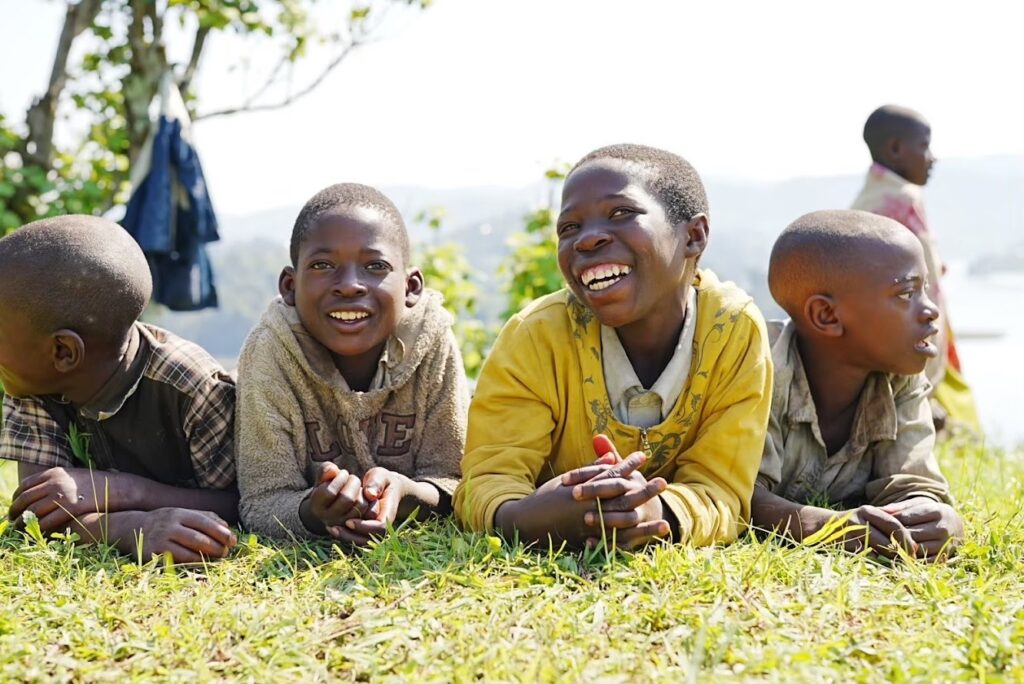
そこに暮らす人々の“生き様”が、言葉にできない強さで迫ってくるからだ。
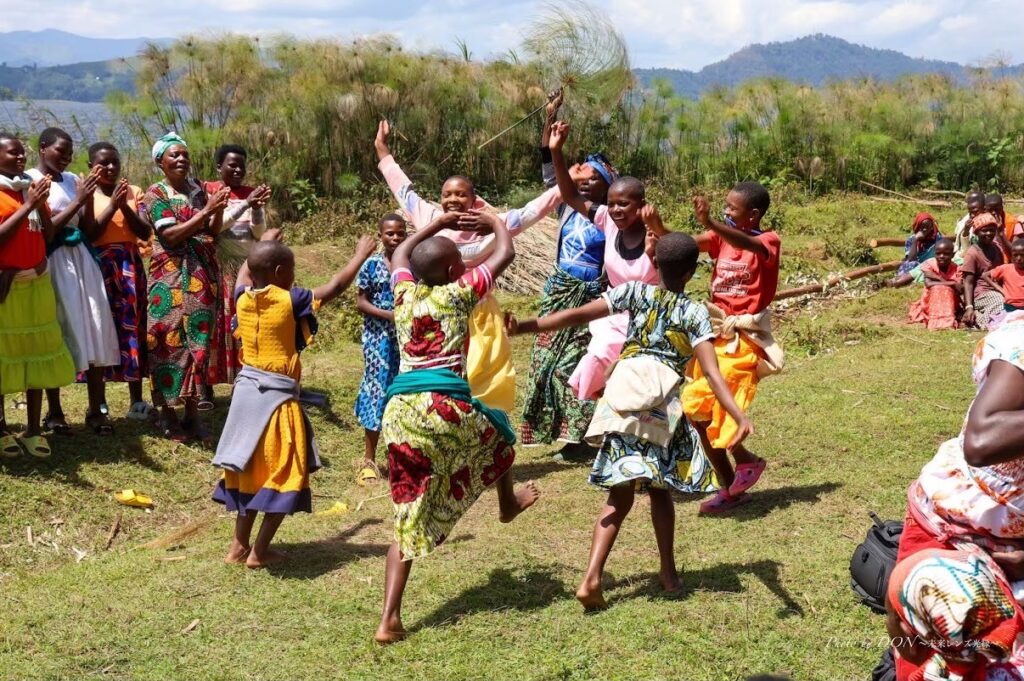
祈っている姿が美しい。ご飯をつくる姿が美しい。
そして、踊りが“技術”ではなく“喜びそのもの”として立ち上がっている。
日本でダンスを踊るときに混ざりがちな「どう見えるか」「合っているか」といった思考が、そこでは消えている、と語った。
「本当に純粋に喜んでいるのを、ありのまま表現してくれてる。それが圧倒的に伝わってきて…。」
この場所を「世界一幸せのモデルコミュニティの一つにする」と決めた背景には、理屈よりも、体感としての確信があった。
「共通の価値観」を世界で共創する──105ヶ条の憲章という試み
五大陸から人が集まれば、価値観は当然ずれる。
宗教観も文化も、当たり前も違う。だからこそ、「愛」を掲げるだけでは成立しない。
高須さんが語ったのは、価値観の“共通言語”を、議論と共同生活と実践を通してつくっていく構想だった。
その核の一つが「105ヶ条の憲章」。本人はすでに30ほどを叩き台として作ってみたというが、それは完成形ではなく、各国のリーダーと一緒に磨いていく前提だ。
「僕の叩き台でしかないので…世界の共通の愛の価値観みたいなのを築いていく。」
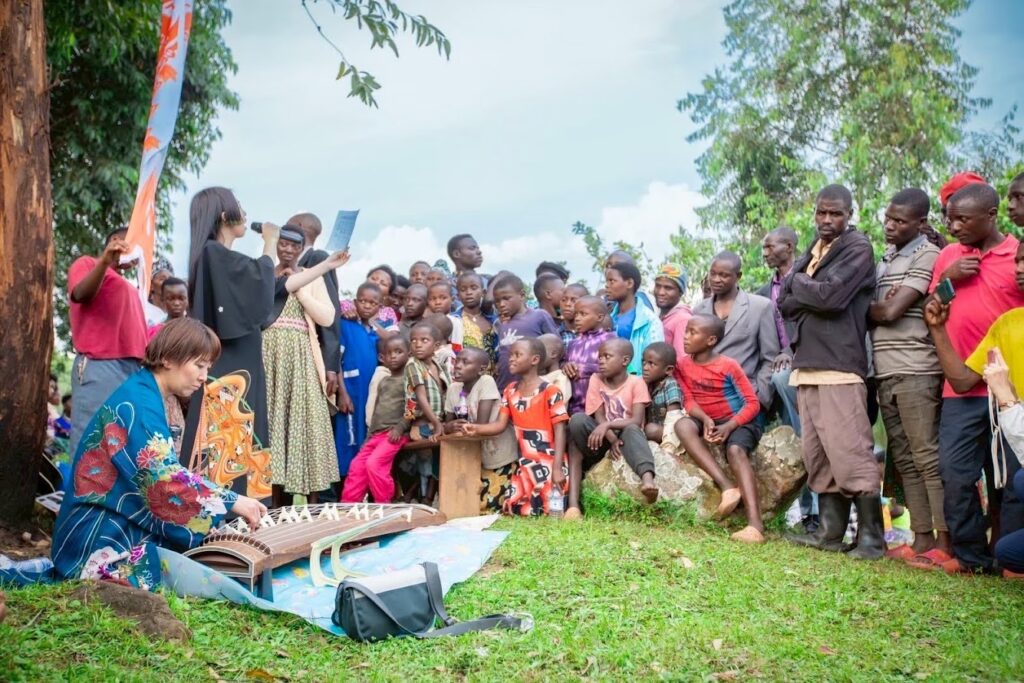
さらにコミュニティの中で叶えていきたい理想として、教育・医療・文化・経済・芸術・祈りなどの領域が挙げられた。
ここでも彼の特徴は、「建築やインフラだけがコミュニティの専門家ではない」という捉え方にある。
統合医療、オルタナ教育、伝統工芸(益子焼・草木染めなど)。
暮らしと未来に関わるあらゆる分野のプロフェッショナルが必要だ、と語る。
「作る」だけでなく、「どう在るか」を含めた設計思想が見えてくる。
SDGsの次へ──「リジェネレイティブ(再生)」という時代感
インタビューの中で印象的だったのが、「持続(サステナブル)」の次の視点として語られた「リジェネレイティブ」という言葉だ。
維持する、減らす、抑える、ではなく。
自然も人も、それぞれが主役として“活性化し、再生していく”世界観へ。
高須さんは、世界の潮流がようやくそこに乗ってきている感覚がある、と話した。
「サステイナブルの時代に入って、これからリジェネレイティブっていう時代に入ってくる。」
ここで彼が目指しているのは、人間都合の「環境に優しい」ではない。
自然と人間の関係性そのものを、主客を入れ替えるように再設計すること。
エコビレッジという言葉で片付けきれない感触が、確かにあった。
グローバルに必要な資質──「開拓力」と「融和力」
最後に、高須さんが挙げた“グローバルなリーダーに必要な素質”は明快だった。
それは、語学力より先にある。
未知へ踏み込む「開拓力」。
違いを尊重し、一つになっていくための「融和力」。
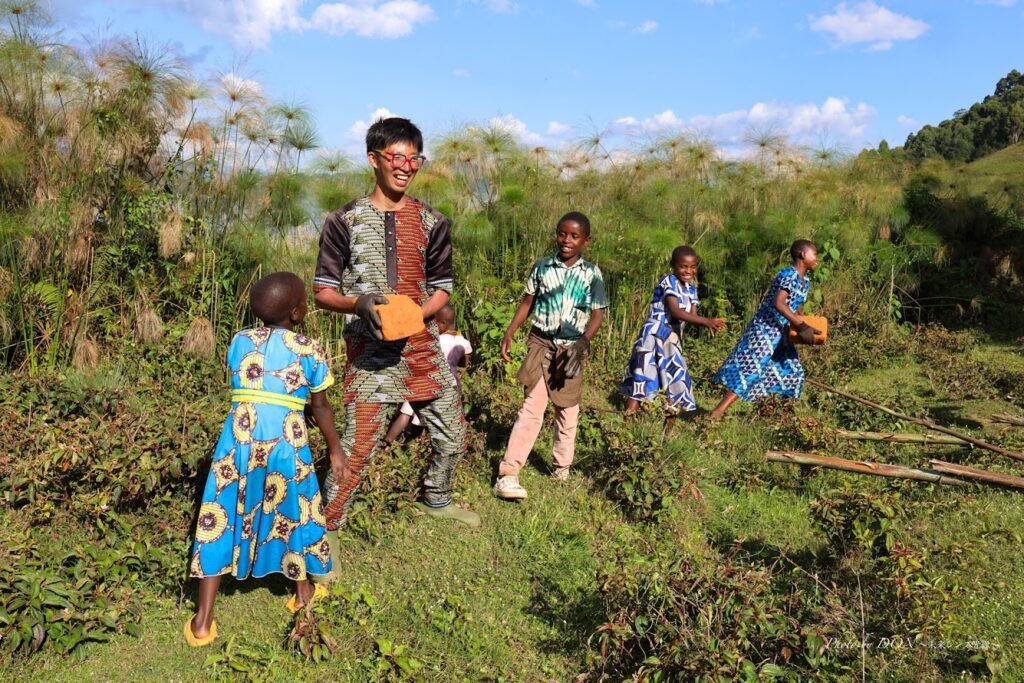
ミュータンダ湖に初めて“ちゃんと入ってきた外国人”が自分だった、というエピソードも語られた。
道がない場所をボートで進み、草をかき分けて上陸する感覚は、まさに開拓そのものだ。
そして同時に、現地に“入らせてもらう”という姿勢。
言語だけでなく、非言語でも分かり合う必要性。
この両輪が、彼の言う「異文化理解を超えた異文化調和」へつながっている。
「言語だけじゃなく、非言語でも分かり合えるというところが大事。」
もし、この人生が一本の映画だとしたら
インタビューの最後に、恒例の質問を投げかけた。
「もし、高須さんのこれまでの人生が一本の映画だとしたら、タイトルは何ですか?」
少し考えたあと、彼はこう答えた。
「地球は、愛の星。」
壮大すぎる、と感じる人もいるかもしれない。
けれど、ここまで話を聞いてきたあとだと、不思議とその言葉は誇張には聞こえなかった。
便利さや効率が進化しても、
人の心が満たされるとは限らないという違和感。
物質文明が発展するほど、精神文明が置き去りにされてきた感覚。
そのズレに、ずっと引っかかり続けてきた人生。
だからこそ彼は、「愛」という目に見えないものを、
思想ではなく、暮らし・建築・教育・医療・経済を含んだ“文明”として形にしようとしている。
愛の話を、夢物語で終わらせないために
「地球を愛の星にしたい」と言うだけなら、簡単だ。
けれど高須さんは、それを一つの場所で検証し、実装し、持ち帰れるモデルにしようとしている。
ウガンダ・レイクミュータンダという具体的な場所。
105ヶ条の憲章という具体的な試み。
建築、エネルギー、教育、医療、文化を横断する具体的な設計。
そこには、「信じているからやる」というより、
「違和感から目を逸らさなかった結果、ここに辿り着いた」というリアリティがあった。
トップに立つ英雄でも、理想を叫ぶカリスマでもない。
自分を「渦の中心」「地球の代理人」と表現した彼の言葉どおり、
このプロジェクトは、誰か一人のためではなく、
関わる人それぞれが主役になる余白を残して進んでいる。
2050年。
その時、天地(あわ)の宮がどんな形になっているかは、まだ誰にも分からない。
ただ一つ確かなのは、
この場所で試みられているのは「正解の提示」ではなく、
人がもう一度、“どう生きたいか”を思い出すための問いそのものだということだ。
🇺🇸英語
A Civilization of Love Begins by a Breathtaking Shore
Takasu Kazuharu’s Vision for the “Awa no Miya” Project in Uganda
Living in Tokyo, one can’t help but feel how the meaning of “family” has gradually grown smaller.
The nuclear family has become the norm, and the distance between neighbors often closes only when there is a specific reason to do so.
And yet, there are places in the world where boundaries remain far more fluid.
Places where mutual support exists not as a system, but as something closer to breathing.
The Awa no Miya Project, to which Takasu has devoted his life, began in such a place—by the shores of Lake Mutanda in southwestern Uganda.
His aim is to shape an international community by the year 2050—one involving people from over 100 countries across five continents.
Yet building a “community” is not the ultimate goal.
Again and again, Takasu returns to a single word: love.
And beyond that, an even larger idea—to implement love as a civilization.
Why Build an International Community Toward 2050?
Takasu’s vision of an international community may sound overwhelming at first.
But as his story unfolds, it becomes clear that his intention is not scale for its own sake, but the creation of a model—something that can be tested, refined, and eventually carried back into the world.
Modern society has achieved remarkable technological and material abundance, yet happiness has not increased in equal measure.
Convenience and fulfillment do not align as neatly as we once assumed.
This dissonance lies at the core of his thinking.
“It’s not just about selling new products or making life more convenient. Sometimes, happiness exists precisely within inconvenience.”
Between visible progress and inner fulfillment, Takasu sensed a widening gap.
The Awa no Miya Project emerged from his desire to examine that gap in one place—and offer it as a living model to the world.
“Jomon Values × Modern Technology”: Not Returning, but Integrating
Takasu often uses the word Jomon, referencing Japan’s ancient era known for communal living and mutual support.
But this is not a call to return to the past.
Instead, he speaks of integrating Jomon-style values of cooperation and shared life with contemporary technology, creating something suitable for our time.
He calls this synthesis a civilization of love.
At the heart of this idea is a perspective on distance—between people.
Where urban life often hardens boundaries, parts of Africa still preserve a sense of closeness.
“If a neighbor is in trouble, you lend salt, spices—there’s no clear boundary between people.”
This communal sensibility is not idealized blindly.
Rather, Takasu seeks to carry it forward by combining it with modern tools, allowing it to evolve into the future.
What Takasu Means by “Love”
Love is a word with countless interpretations.
Takasu himself admits how difficult it is to define, yet he has shaped his understanding through lived experience.
In Africa, he encountered a profound sense of acceptance—a warmth that embraces all.
In Japan, he found attentiveness—the ability to sense subtle changes in others and adjust accordingly.
He shared an experience from a traditional inn, where the timing and dilution of a glass of plum wine were carefully calculated while he bathed, ensuring it would be perfect upon his return.
To him, this embodied a Japanese form of love—one rooted in reading the other person.
“To be close to someone means sensing what they need, moment by moment, and responding from their perspective.”
He also referenced the spirit of do—the “way” found in tea ceremony, martial arts, and flower arrangement—where harmony takes precedence over victory, and even invisible spaces are treated with care.
Love, in this sense, is not mere kindness.
It is a form of awareness that extends beyond what the eye can see.
Lake Mutanda: Where Beauty and Love Still Remain
The heart of the project lies around Lake Mutanda.
Takasu reached this place after traveling through more than ten African countries, yet something here felt unmistakably different.
It was not only the scenery, but the way people lived.
Prayer looked beautiful. Cooking looked beautiful.
Dance arose not as technique, but as pure joy.
In contrast to the self-consciousness that often accompanies performance in modern societies, here there was no concern for appearance or correctness—only expression.
“They express joy exactly as it is. That purity comes through overwhelmingly.”
This visceral certainty led him to decide that Lake Mutanda would become one of the world’s models for a truly happy community.
Co-Creating Shared Values: The 105 Principles
When people from five continents gather, differences are inevitable.
Religion, culture, and assumptions all diverge.
For this reason, simply declaring “love” is not enough.
Takasu proposes building a shared language of values through dialogue, communal living, and practice.
At the center of this effort is a 105-article charter, currently in draft form.
“What I’ve written is only a starting point. We’ll shape it together into shared values of love.”
Education, healthcare, culture, economy, art, and prayer all feature as essential dimensions.
Notably, he emphasizes that community-building expertise is not limited to infrastructure alone.
Traditional crafts, integrative medicine, alternative education—any profession connected to life and the future has a place.
The project is as much about how to be as it is about what to build.
Beyond Sustainability: Toward Regeneration
Another striking theme in Takasu’s vision is his emphasis on regeneration.
Beyond sustainability—which focuses on maintaining and reducing impact—he speaks of activating life itself.
“After sustainability, we enter the era of regeneration.”
Here, nature is no longer something humans manage, but a co-participant.
This shift reframes humanity not as steward alone, but as one of many protagonists within a living system.
The Awa no Miya Project cannot be neatly categorized as an eco-village.
Its ambition lies deeper, at the level of relationships.
Essential Qualities for Global Leadership
When asked what qualities global leaders truly need, Takasu’s answer was clear.
First, the power to pioneer—the courage to step into the unknown.
Second, the power to harmonize—to respect difference and weave unity from it.
He recalled arriving at Lake Mutanda before any established path existed, navigating by boat and cutting through vegetation to reach land.
Yet just as important was the mindset of entering humbly—being allowed in.
“Understanding each other goes beyond language. Non-verbal connection matters just as much.”
If This Life Were a Film
At the end of the interview, a familiar question was posed:
If your life were a film, what would its title be?
After a brief pause, Takasu answered:
“The Earth Is a Planet of Love.”
At first, the phrase may sound grand.
Yet after hearing his story, it no longer felt exaggerated.
His life has been shaped by a persistent discomfort—the sense that material progress has outpaced spiritual fulfillment.
Rather than ignoring that discomfort, he chose to give it form.
Not as ideology, but as lived reality.
Not as a dream, but as a testable civilization.
Keeping Love from Becoming a Dream
Anyone can say they want the Earth to be a planet of love.
What sets Takasu apart is his insistence on grounding that vision in a real place.
Lake Mutanda.
A charter of shared principles.
Concrete experiments across architecture, energy, education, and culture.
This is not the work of a hero standing above others, nor a charismatic figure proclaiming ideals.
Takasu describes himself instead as the center of a vortex—a point around which people gather.
The year 2050 still lies ahead.
What Awa no Miya will ultimately become remains unknown.
Yet one thing is certain:
This project does not offer answers.
It offers a space where people can remember how they want to live.
【PROFILE】
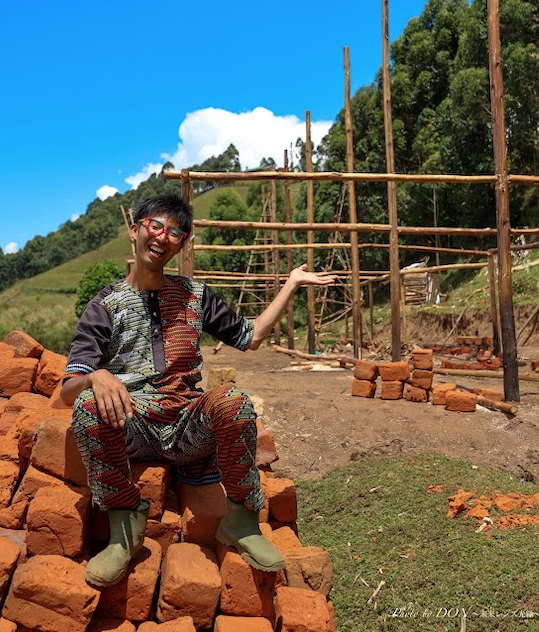
高須多明(Kazuharu Takasu)
天地(あわ)の宮プロジェクト リーダー
ウガンダ・レイクミュータンダ周辺を拠点に、2050年に向けた国際コミュニティ構想を推進。「縄文的な助け合いの価値観」と「令和のテクノロジー」を融合させ、教育・医療・文化・経済・芸術・祈りなど多分野の専門家と共創しながら、“愛の文明”のモデルづくりを目指している。
Kazuharu Takasu
Leader of the Awa no Miya Project
Based around Lake Mutanda in southwestern Uganda, Takasu is leading an international community initiative toward 2050. By integrating Jomon-inspired values of mutual support with modern technology, he collaborates with experts across education, healthcare, culture, economy, art, and spirituality to explore a living model of a “civilization of love.”

【PROFILE】
真綺(Maki)
語りの芸術家/インタビュアー/コミュニケーション・スペシャリスト
8年間“しつもん力”を教え、日本語と英語の間で人の想いを橋渡ししてきた。
これまで国内外で、経営者、アーティスト、国際的イベントの登壇者など延べ数千人と対話。
世界的な授賞式や王室叙任式のスピーチ・通訳も担当し、言葉と存在感の両面から人の魅力を引き出す。
Maki
Word Painter / Interviewer / Communication Specialist
For eight years, Maki has taught the art of asking powerful questions, bridging stories between Japanese and English.
She has engaged in thousands of conversations with business leaders, artists, and speakers at international events, both in Japan and abroad.
Her work includes speeches and interpretation for global award ceremonies and royal investitures, capturing and conveying the essence of a person through both words and presence.
経営者の存在感を、言葉とストーリーに刻む。
真綺による日英インタビューにご興味のある企業様はこちらからお問い合わせください。

コメント